
Paul’s Experience of the Cross in a Polarized World (part 2)

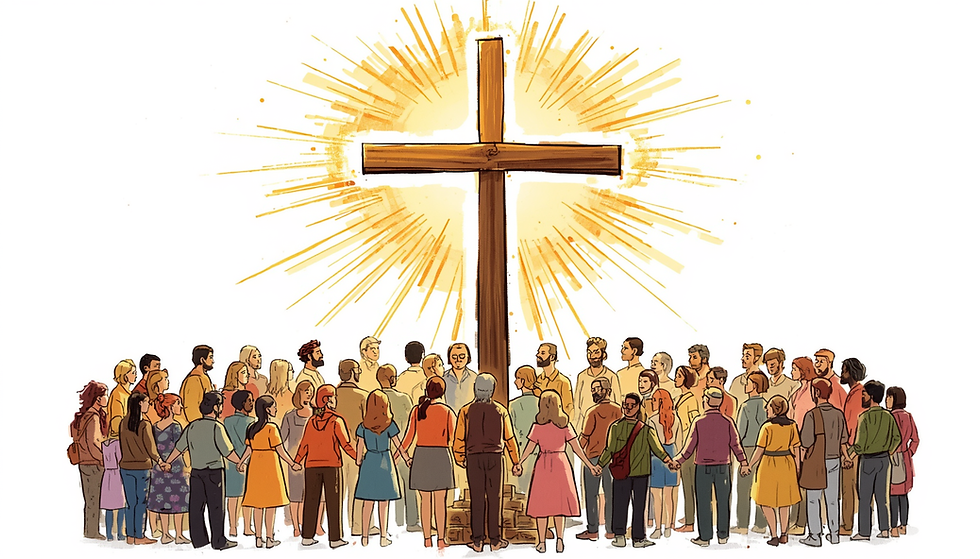
Historically, Jesus’ command to “take up your cross” and “deny yourself” has been applied to personal holiness in a way that often devolves into spiritual fratricide. When believers elevate their own standards of holiness or self-denial, they inevitably judge and separate themselves from those who do not meet those criteria. Another misapplication is to use the cross to force conformity on those whose convictions are contrary to leadership or the majority. However, the cross of Jesus Christ was never intended to create isolated, "super-spiritual" individuals or a robotic uniformity in the name of unity. Instead, the cross was designed to break down the "middle wall of hostility" and create One New Man—the ekklesia—where diversity is not only welcomed but necessary.
The Denial of Religious Identity
The apostle Paul perfectly exemplified this unifying experience of the cross. For Paul, bearing the cross was not a tool for ascetic self-punishment or denying worldly pleasure merely for the sake of being "holy." Rather, he experienced the cross as the profound denial of his own preferences, glory, and cultural biases.
When Paul declared, "I have been crucified with Christ" (Gal. 2:20), he was pointing to the termination of the "old man"—the fallen nature that thrives on enmity and pride. He famously rebuked Peter in Antioch because Peter, fearing the "circumcision party," withdrew from the Gentiles to maintain a facade of Jewish "purity." Peter was choosing forced uniformity with his religious tribe over the organic oneness of the Body. To Paul, this retreat into tribal safety was a rejection of the cross; if we rebuild the walls of division, then Christ died in vain (Gal. 2:21).
Flexibility as the Practical Cross
Paul’s self-denial was radically outward-focused. In 1 Corinthians 9:19–22, he states that he became "all things to all men," including believers, to minister Christ and gain them. This flexibility—the willingness to fit into the environments of others—is the practical, daily application of taking up the cross. If Paul had expected others to conform to his background or religious preferences before he served them, he would have remained a sectarian Pharisee.
This flexibility mirrored the incarnation of Jesus. Just as Christ emptied Himself of His heavenly status (Phil. 2) to fit into man’s lowly surroundings, Paul laid aside his "rights" and religious pedigree. By declaring the "world has been crucified to me," Paul signaled he was dead to the divisive categories of his era (Jew, Greek, master, slave). The cross freed him from the need to demand conformity from others; instead, it empowered him to adapt himself for the sake of the ekklesia.
Disagreement Without Offense: The Acts 15 Model
Crucially, we must distinguish between individualism (the pride that isolates) and individuality (the distinctiveness of the person). The cross does not terminate an individual’s freedom of conviction, nor was it intended to be a mallet to crush unique perspectives. We see this vividly in Acts 15 during the "sharp disagreement" between Paul and Barnabas over John Mark. Their differing perspectives resulted in two separate mission trips, because neither was required to "deny their opinion" for the sake of forced uniformity.
The working of the cross was evident in the absence of personal offense. Paul continued to highly appraise Barnabas as a sacrificial servant (1 Cor. 9:6), and John Mark was later welcomed into Paul’s own service. Their story proves that taking up the cross does not mean the end of disagreement or the suppression of one's conscience; it means the end of the enmity that usually follows it. The cross allows for a "democratic assembly" where members can differ in conviction and direction while remaining in the same Spirit.
Death Working in the Minister, Life in the Body
Paul experienced the cross by voluntarily suffering for the ekklesia, the Lord’s Body (Col. 1:24). He viewed his hardships not as a badge of personal merit, but as a means of dispensing life to others: "So then death is working in us, but life in you" (2 Cor. 4:12). While Paul endured the "death" of his own reputation, comfort, and cultural safety, the resurrection life of Jesus was simultaneously ministered to those around him. He did not use the cross to force others to "get in line"; instead, he rested in the death of Christ so that life could flow out to enliven others—even those who held contrary opinions.
Contemporary Application: Breaking Today’s Walls
Today, the "middle wall of hostility" is rarely about ancient dietary laws, yet the spirit of division remains the same through extreme "siloing" and "virtue signaling." Applying the cross to contemporary issues requires a death to our "rightness" in three specific ways:
Beyond Tribalism: We must "die" to our political and social labels if those labels prevent fellowship. True unity is not forced uniformity where everyone votes or thinks the same, but a diversity that functions in one Spirit.
The Refusal to Cancel: In a "canceling" culture, the cross calls us to stay at the table. True self-denial is being willing to lose one’s reputation among a "pure" group in order to maintain unity with a "diverse" group.
Absorbing the Death: In current disputes, we often prioritize "winning the argument." The Pauline application is to "absorb" the insult—letting our ego take the "death"—so that the relationship and the ekklesia can have "life."
Conclusion
Ultimately, Paul’s life demonstrates that the cross is not an instrument for isolating oneself in personal holiness, nor is it a tool to suppress an individual’s freedom of expression. The cross is the ultimate display of sacrificial service. By refusing to demand conformity and instead flexibly accommodating the varied backgrounds of those around him, Paul lived out the central achievement of the cross: breaking down the wall of hostility to make peace and build up the Lord's Ekklesia (democratic assembly). To take up the cross today is to value the fellowship and unity of the One New Man more than the satisfaction of being right or the power of being in control.
Comments