
The Cross Slays Spiritual Pride and Forced Uniformity
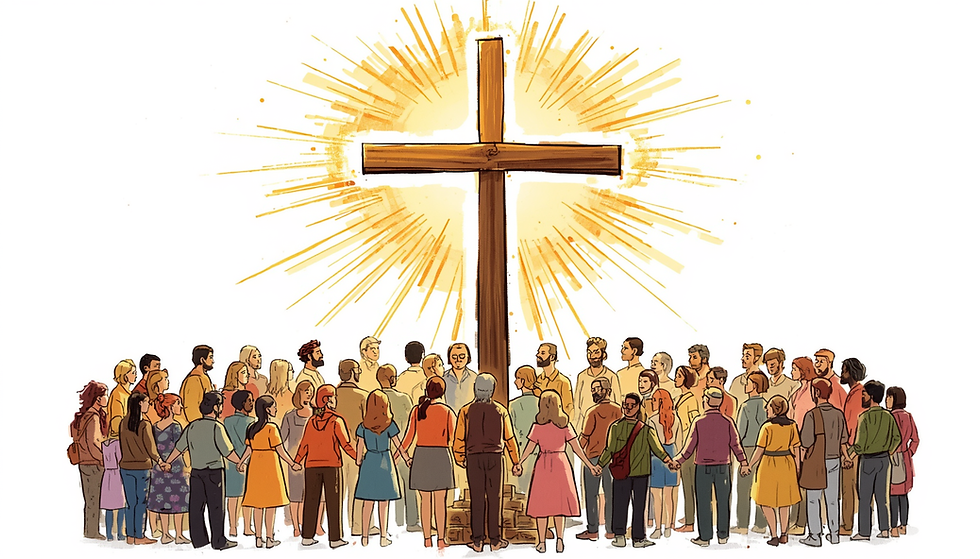
The cross of Christ is the central pillar of the Christian faith, yet it is often viewed through a narrow lens. Traditionally, it is seen as the means of personal salvation and an instrument for individual sanctification. While foundational, these aspects do not represent the full scope of the cross. A contextual reading reveals it is also a horizontal instrument designed to abolish enmities and establish the Lord’s democratic assembly (ekklesia). Focusing exclusively on personal holiness can inadvertently foster division. The true experience of the cross is the creation of a unified, corporate "One New Man" where the diversity of the Body functions in the unity of the Spirit.
II. The Traditional Application: The Cross as Personal Sanctification
In many traditions, the cross is focused almost exclusively on the "self," treated as a tool for daily self-denial and the "mortification of the flesh." The objective is developing personal character and a "victorious" spiritual life. While the pursuit of holiness is scriptural, this focus can fall into a psychological trap. When the cross is reduced to a project of self-improvement, it can nourish the "religious ego." The "self" is not abolished but refined into a version that takes pride in its own success in self-denial—becoming a badge of achievement rather than a means of communal integration.
III. The Pitfall: Spiritual Pride and the "Inner Ring"
When treated as a personal project, the cross creates a "Hierarchy of Sacrifice." Believers construct a spiritual "ladder," comparing their "brokenness" or "surrender" to others. This comparison is the bedrock of the "holier than thou" attitude. Dietrich Bonhoeffer warned that "self-chosen holiness" alienates the believer from the community. Thomas Merton identified a "Religious Ego" that uses spiritual disciplines to feel superior. Similarly, C.S. Lewis described the "Inner Ring," where the "cross-bearer" feels a sense of superiority over the "unspiritual" masses, building walls instead of tearing them down.
IV. The Weaponization of the Cross: Forced Uniformity vs. True Unity
A further misapplication of the cross is its use as a control mechanism to force uniformity. In many environments, believers are pressured to "deny themselves" by suppressing their opinions, feelings, or convictions whenever they diverge from leadership or the majority. In this distorted view, voicing a contrary thought is labeled as "individualism" or "divisiveness." Believers are told to "bear the cross" simply to avoid disrupting the status quo.
This is not the cross; it is coerced conformity. True self-denial is not the silencing of one’s conscience to suit a hierarchy. On the contrary, those bearing the cross of Christ possess an expanding love to receive those who are different and even contrary. That is the testimony of Jesus, the ultimate cross-bearer. The authentic experience of the cross grants others the freedom to be distinct in their journey, allowing us to accept them exactly as they are. God’s ekklesia is not a collection of crushed individuals; rather, the cross kills the enmity between individuals so their distinctiveness can shine without causing division.
V. The "Democratic Assembly" Perspective: The Horizontal Cross
God’s democratic assembly shifts the focus from "me dying to my sins" to "the cross killing the distance between us." In this horizontal view, the cross is the Great Equalizer. Its primary corporate function is to remove the labels, ranks, and religious barriers that prevent the functioning of a democratic assembly. Crucially, the outcome is not a forced "sameness," but the one Body of Christ composed of varied individuals.
Just as the Trinity exists in diversity-in-unity, the ekklesia manifests this same reality. The cross levels the ground, ensuring no member can claim higher status or demand that others conform to their image. Applied horizontally, the cross does not demand the death of one’s personality, but the death of the demand for conformity. It results in love, peace, and functional oneness rather than spiritual elitism or dominating control.
VI. Key Scriptural References and Contextual Re-evaluation
Ephesians 2:14-16: Paul discusses the peace of the cross, specifically addressing the deep-seated division between groups—Jew and Gentile. He states the cross "abolished the enmity" to create "in Himself one new man." The cross was the specific tool used to kill the hostility toward difference, allowing disparate groups to function as one assembly without losing their distinctions.
John 11:52: This highlights the "gathering" intent of the crucifixion, noting Jesus died to "gather together in one the children of God who were scattered abroad." This demonstrates that the cross is centrifugal (outward-moving) and unifying. It pulls scattered, unique individuals into a single democratic assembly rather than forcing them into a single mold.
Matthew 16:16-24: There is a chronological link here: only after declaring "I will build My ekklesia" did Jesus begin to teach about the cross. This shows the cross is the means by which barriers of fellowship are broken between distinctive members. We take up the cross not to silence our brothers, but to slay our own pride that refuses to fellowship with them.
VII. Conclusion
The cross was never intended to be a private trophy or a tool for personal bragging rights, nor was it intended to be a mallet to force uniformity. Using it solely for personal piety risks creating the very pride and division Jesus died to abolish. By reclaiming its horizontal context, we see the cross as the foundation of the Lord’s democratic assembly.
It is the instrument that makes "diversity in unity" possible. It does not produce "holy" loners or "compliant" clones; it produces a community where diverse believers are matured into one. In His democratic assembly (ekklesia), the cross slays enmity, makes peace, and allows the glory of the Trinity to be manifested through a unified people. When we stop looking "up" at our own holiness or "down" at those contrary, we can look "across" at our brothers and sisters and see the beauty of the One New Man.

It's like wearing a pair of 3D lenses. The vista is wide, high, and so deep. Holistically life-giving and inclusive! Thank you so much!
I can’t get enough of this message of unity without conformity (to anyone other than Christ). Life giving. Thirst quenching.
Beautiful!